
Making our roads safer is a key commitment in Police and Crime Commissioner Joy Allen’s Police, Crime and Justice Plan. A strong supporter of the Vision Zero approach (the belief that no death on our roads should ever be considered inevitable) she explains, in her own words, why the simple action of wearing a seatbelt can reduce the risk of death in a collision.
Sadly, every day across England and Wales, an average of five people lose their lives and 68 more are seriously injured on our roads.
Yet many of these lives could have been saved by doing one simple thing: wearing a seatbelt.
In 1983 the UK introduced one of the most important road safety laws in modern history, making seatbelts compulsory for drivers and front-seat passengers. At the time it sparked debate and resistance, but it has undoubtedly saved precious lives.
Seatbelts are estimated to have saved tens of thousands of lives in Britain and continue to save hundreds more every year. They reduce the risk of death in a collision by around 50 percent.
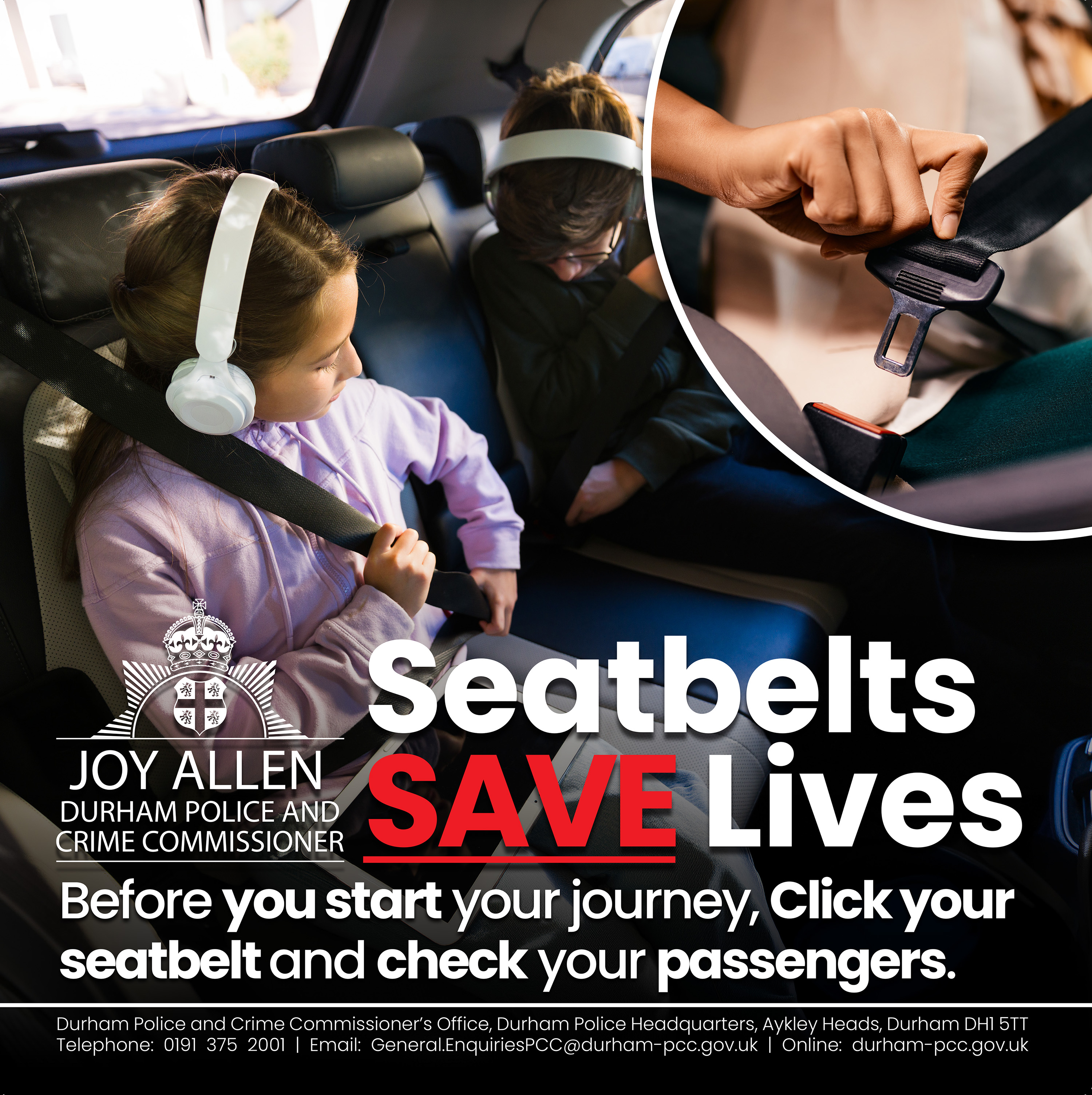
And yet some people are still breaking the law and risking their lives.
Government data shows that around one in three vehicle occupants killed in collisions were not wearing a seatbelt. These deaths could have been prevented if they had worn their seatbelt.
These are national figures but this is happening on our roads. A recent seatbelt enforcement operation carried out by Durham Constabulary’s Roads and Armed Policing Team during the February half-term produced some shocking results.
One driver received three separate tickets in just one week for failing to wear their seatbelt, totalling £300 in fines. But what concerned officers even more was that when some drivers were stopped, children travelling in the vehicle were also unrestrained.
Children learn by watching the adults around them. If parents treat wearing a seatbelt as optional, children will copy them.
But in a collision, the consequences can be deadly.
Failure to wear a seatbelt is one of the behaviours linked to the most serious collisions, alongside speeding, drink or drug driving and driver distraction such as mobile phone use.
As Police and Crime Commissioner, making our roads safer is a key commitment in my Police, Crime and Justice Plan because it was one of the publics top priorities. In my national role as APCC Joint Lead for Roads Policing, I also work with partners across the country to reduce deaths and serious injuries on our roads.
I strongly support the Vision Zero approach, the belief that no death on our roads should ever be considered inevitable.
To achieve this ambition we must use every tool in the box to save lives - education, encouragement, enforcement and engineering. Here in County Durham and Darlington, Durham Constabulary is deploying advanced roadside technology that is capable of detecting drivers using mobile phones or not wearing seatbelts.
But road safety is not just about enforcement or technology. It is about personal responsibility.
Before you start your journey Click your seatbelt. Check your passengers.
Because the life you save could be your own or someone you love and no family should have to endure the heartbreak of losing someone so needlessly.
Ends
Communities share their views on rural crime across Co Durham & Darlington, helping shape future prevention, investment & policing priorities
PCC Joy Allen has welcomed the Government’s decision to block the early release of offenders convicted of unlawful killing
PCC Joy Allen explains why, when considering an E-Scooter as a gift, people should consider whether the recipient will be able to use it legally.


